
Canton, Georgia--(Newsfile Corp. - October 16, 2026) - The federal tax deduction for energy efficient commercial buildings, known as 179D, closed on June 30, 2026, to any project that had not yet begun construction. Buildings already in service and projects already underway can still claim it, and so can the architects and engineers who designed qualifying public buildings, says David Wiener, host of The Tax Strategy Playbook podcast.
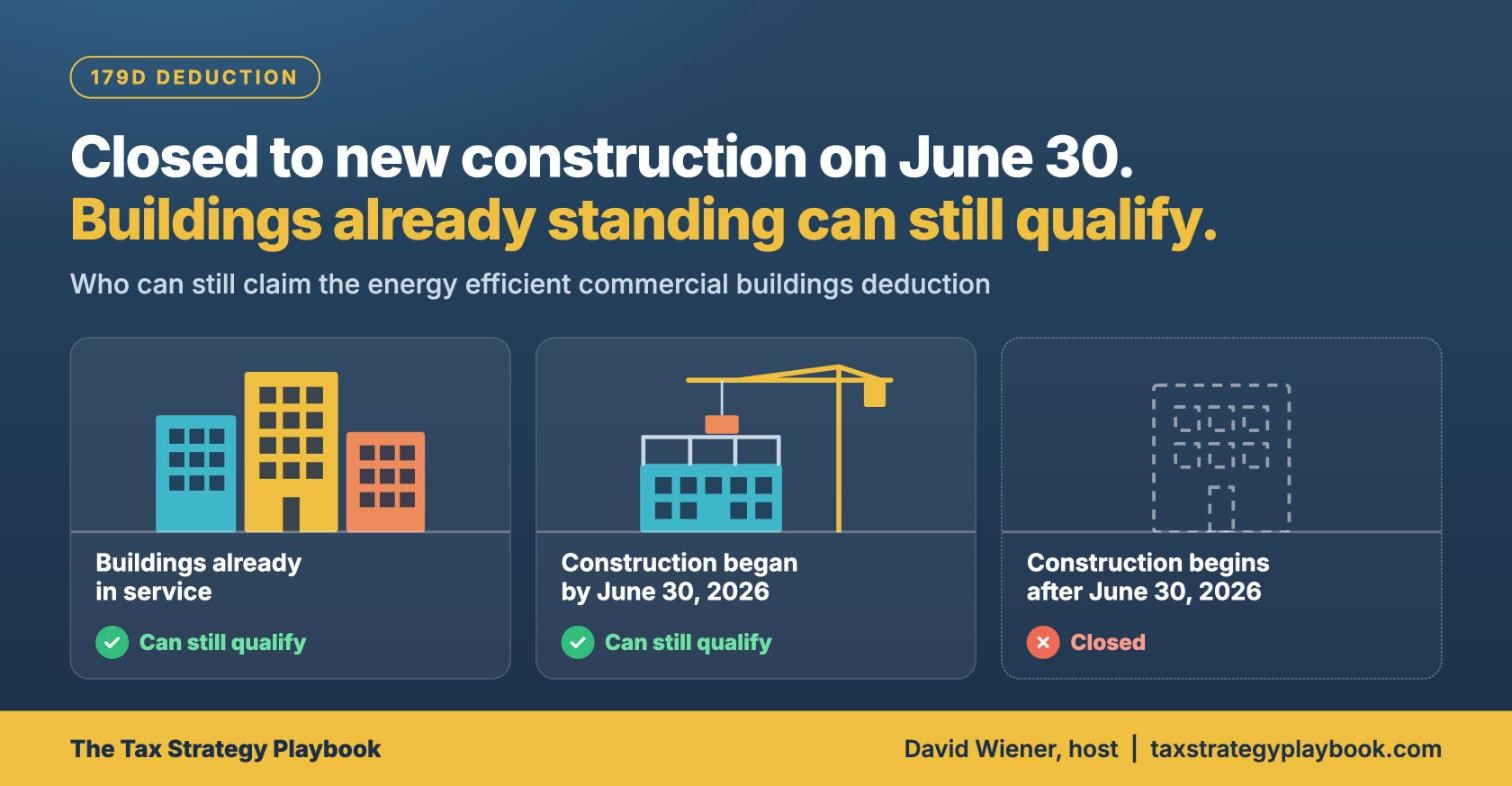
To view an enhanced version of this graphic, please visit:
https://images.newsfilecorp.com/files/10373/318774_226a311c84c0aa80_001full.jpg
The cutoff comes from the One Big Beautiful Bill Act (Public Law 119-21). The IRS instructions for Form 7205, revised December 2025, say the law "terminated the section 179D energy efficient commercial buildings deduction for property the construction of which begins after June 30, 2026."
"The owners I talk to hear the word 'terminated' and assume the whole thing is gone," Wiener said. "Congress shut the door on projects that had not started. It took nothing back from a building that is already standing."
Three groups can still claim the deduction.
Owners of buildings already in service. An owner who installed qualifying lighting, heating and cooling, hot water, or building envelope improvements in any year since 2006 and never claimed 179D can generally claim the missed deduction on a current return. The owner files Form 3115, a change in accounting method, and does not have to amend old returns. Apartment buildings of four stories or more count, along with offices, warehouses, hotels, and other commercial buildings.
Developers with projects underway. A project that started in May 2026 and opens in 2028 can still qualify, because the date that counts is the day construction began. The deduction is claimed for the year the property is placed in service. Owners whose start date fell close to the deadline should keep records that show when construction began.
Architects, engineers, and other designers of public buildings. When a building is owned by a government or, for property placed in service after 2022, by a tribal government or a tax-exempt organization, the owner can allocate the deduction in writing to the person primarily responsible for designing the energy efficient property. A designer with an allocation from a government owner cannot use Form 3115. Designers claim the deduction for the year the property was placed in service, so a return already filed has to be amended while that year is still open. That is generally three years from the date the original return was filed.
For tax years beginning in 2026, the IRS instructions set the deduction at $0.59 to $1.19 per square foot, depending on energy savings, and at up to $5.94 per square foot for projects that meet prevailing wage and apprenticeship requirements. On a 100,000 square foot building, that is $59,000 to $119,000 at the base rates and as much as $594,000 at the top rate. Earlier years carry their own rates, which topped out at $1.80 per square foot for tax years beginning before 2021. The deduction cannot be more than the cost of the qualifying property, and every claim needs a certification from a licensed professional.
"My father was a CPA, and he taught me that tax evasion is a crime, but tax avoidance is mandatory," Wiener said. "Congress wrote this deduction for these buildings. An owner who qualifies and never claims it has paid tax the law did not ask for."
Wiener covers both situations in Episode 30 of The Tax Strategy Playbook, "179D Is Not Dead: Claim It on a Building You Have Owned for Years," at https://www.taxstrategyplaybook.com/179d-deduction/.
This release is general education. Whether a specific building qualifies depends on its facts, and that call belongs with the owner's or designer's own tax professional.
About David Wiener and The Tax Strategy Playbook
David Wiener, known as Mr. Cash Flow, is the founder and CEO of Cash Flow Strategies, Inc., in Canton, Georgia, and the host of The Tax Strategy Playbook, a weekly podcast on tax strategy for real estate investors, business owners, and tax professionals. He provides cost segregation, 179D, and R&D tax credit studies through CSSI (Cost Segregation Services, Inc.). New episodes publish every Tuesday at https://www.taxstrategyplaybook.com.
Media contact
David Wiener
770-224-8504, option two
david.wiener@cashflowstrategies.us
https://www.taxstrategyplaybook.com
To view the source version of this press release, please visit https://www.newsfilecorp.com/release/318774
Source: Pressmaster DMCC